

The Indian streaming category is now just over a decade old. After the rapid expansion during and immediately after COVID, Hindi fiction series have now entered a more mature phase. A few successful franchises have endured, and their new seasons continue to play an important role in driving engagement, subscriber acquisition, and platform stickiness. But for the long-term health of the category, platforms need to create new IPs regularly.
That task is becoming tougher in an increasingly-cluttered market. The first wave of breakout Hindi streaming franchises was largely male-centric, with shows such as Sacred Games, Mirzapur, The Family Man, Special Ops, Criminal Justice, Paatal Lok, and Panchayat shaping the mainstream grammar of the category. These franchises continue to perform strongly, but their success also points to a larger challenge: How can a new non-franchise show manage to break through, when category memory is already crowded with high-recall male-led IPs?
The methodology
To explore deeper, we looked at the top 50 most-watched non-franchise Hindi fiction web-series launched between January 2025 and May 2026, and classified them by gender of their protagonist. Each title was classified as Male, Female, or Shared, based on the fundamental question: “Whose story is this show about?” While the question may appear subjective at first glance, most properties offer a clear answer. For those that don’t, Ormax Media’s story-analysis frameworks provide a consistent and objective basis for classification. The breakup of the top 50 is Male (28 series), Shared (12) and Female (10). Even without any further analysis, this breakup confirms that even the non-franchise supply is heavily male protagonist skew. This was the topic of exploration in this November 2025 report published on this website.
Next, we compared the average Buzz for the three sets (Male, Female & Shared). Buzz, a key parameter in Ormax Stream Track, is a measure of % audience who recalled the show unaided, when asked to recall upcoming or recently-launched streaming properties. Buzz is a strong indicator of the talk value of the show, i.e., the degree and effectiveness of conversations around it. In recent analysis conducted to understand audience parameters that impact the viewership of a show. In a recent data modeling exercise conducted by us to identify consumer parameters that have the highest impact on lifetime viewership of an OTT original, Peak Buzz was isolated as the most important enabler of viewership. Peak Buzz is simply the Buzz in the week when it peaks in a show's lifecycle. This typically happens a week or two after the show's launch, though there have been exceptions.
The findings
The chart below plots the Peak Buzz, averaged over all the shows in the three category. Going by the supply skew towards male protagonist shows, one would expect them to be higher on an audience parameter like Peak Buzz too, especially because the OTT universe itself is male-skewed, with 60% audiences being men. But as you can see in the chart, that's not the case!
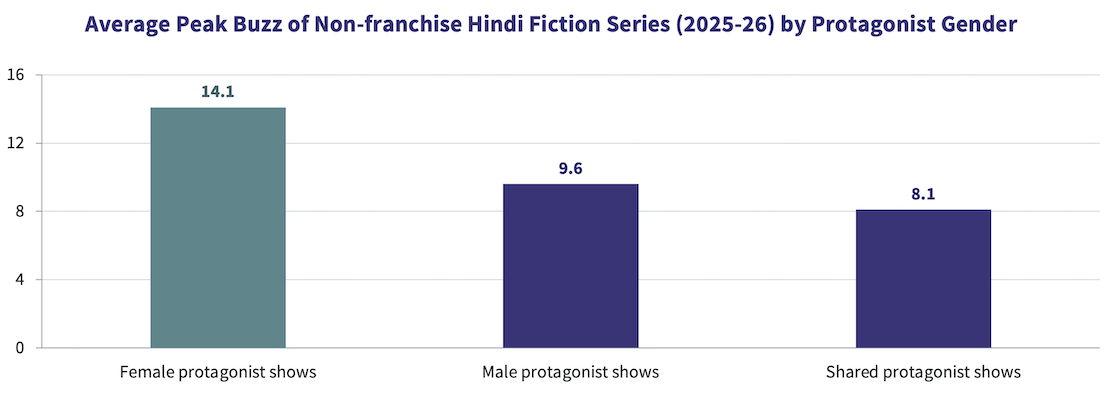
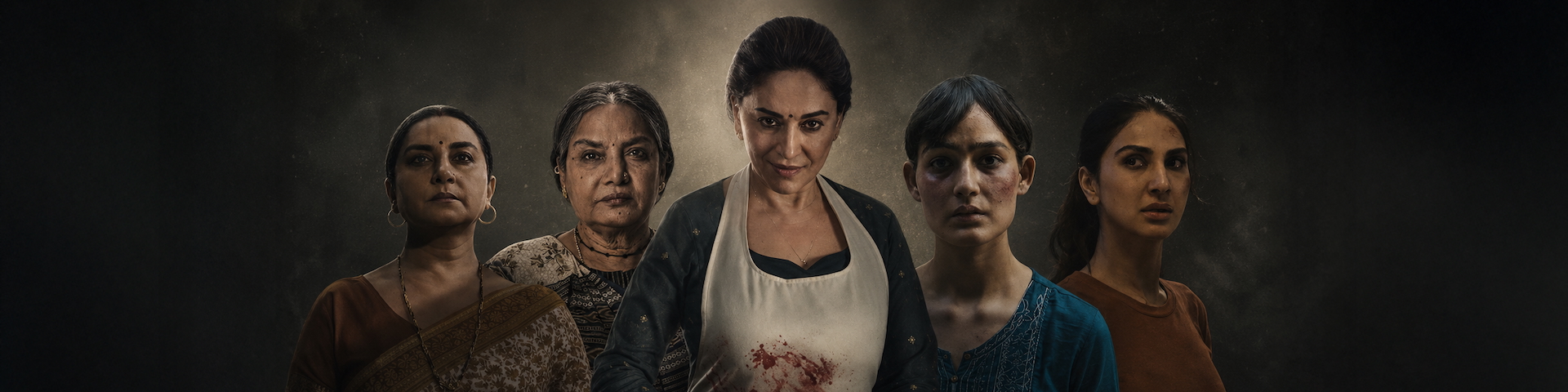
Male-protagonist shows have an average Peak Buzz of 9.6. In contrast, female-protagonist shows deliver significantly higher average Peak Buzz at 14.1, i.e., 47% higher than the average Peak Buzz for male-protagonist shows. Some of the prominent series contributing to this higher Peak Buzz include Mrs. Deshpande, Chiraiya, Mandala Murders, Dabba Cartel, Daldal, Khauf, and Search: The Naina Murder Case.
The finding is clear: Shows headlined by female protagonists are doing more than adding representation value to the category. They are generating stronger pre-release conversation and excitement for new IP, and doing so more than their male-led non-franchise counterparts.
Why female-led shows are generating higher Buzz
What explains this seemingly non-intuitive finding? At least four things.
1. Female protagonist shows are benefiting from relative scarcity
The most obvious explanation lies in supply. Female-led shows account for only 22% of the sample, compared to 52% for male-led shows. In any mature content category, scarcity can become an advantage, especially when the dominant narrative template starts feeling familiar.
Over the last decade, Hindi OTT has built a rich library of male-led stories across genres. Shows such as Mirzapur, The Family Man, Special Ops, and Criminal Justice shaped the crime-action-thriller end of the category, while titles such as Panchayat, Gullak, Kota Factory, and the Scam franchise expanded male-led storytelling into slice-of-life, youth, family, and business-drama spaces. As a result, the male protagonist has become the default lens through which audiences experience Hindi streaming fiction. Female protagonists, by comparison, remain underrepresented, and more so with each passing year, as the analysis from 2025, referred above, suggests. This makes female-led shows more noticeable when they do appear, helping them generate stronger traction.
The effect is particularly visible in the ACT (Action-Crime-Thriller) cluster, where the protagonist imbalance has historically been even more skewed towards men. In this cluster, the scarcity premium is the strongest, which is why most of the top female-led shows on Peak Buzz (with the exception of Chiraiya) are from this cluster.

2. Female-led stories often carry richer layers of meaning
Many male-led shows are consumed primarily through their genre lens. Audiences may engage with them as crime stories, thrillers, action dramas, workplace dramas, or comedies. Female-led stories, however, often operate on two levels. Beyond the surface narrative, they frequently tap into themes of agency, identity, social expectations, safety, ambition, belonging, motherhood, resilience, and systemic barriers.
This gives such shows a wider conversation footprint. Audiences are discussing what happened in the story, along with what the story is saying about contemporary life and society. Recent examples illustrate this well. Khauf functioned as a horror series on the surface, but much of the audience conversation revolved around women’s lived experiences, fear and vulnerability. Chiraiya worked as a rooted drama, but audiences also connected with its themes of domestic violence, consent, marital rape, and dignity. This additional cultural and emotional resonance can contribute to stronger word-of-mouth and pre-release curiosity, helping female-led shows generate higher Buzz.
3. Female-led stories may be better positioned for a co-viewing era
The early years of OTT consumption were largely characterised by individual viewing. Increasingly, however, Connected TV (CTV) is bringing streaming into the shared living-room environment. In such an environment, stories that can appeal across demographic cohorts have a natural advantage in generating conversations. Female-led stories may be benefiting from this shift because they often attract interest beyond a single audience segment, creating broader opportunities for discussion, recommendation and co-viewing.
This does not mean that female-led stories are “for women”. Rather, they may be functioning as more universal entry points into a show, helping them travel across audiences more effectively.
4. Female protagonists provide a clearer marketing asset
In a crowded release calendar, a protagonist can often become the simplest and most effective communication device. Female-led stories frequently provide a clearer positioning cue because they immediately signal a perspective that feels differentiated within the category. This is particularly valuable for non-franchise launches, where awareness must be built from scratch. A differentiated protagonist gives audiences something tangible to remember, helping the show establish a stronger identity before release, especially is the actor playing the lead has strong equity, such as Madhuri Dixit (Mrs. Deshpande), Shabana Azmi (Dabba Cartel), or Konkona Sen Sharma (Search: The Naina Murder Case).
Implications for platforms
The findings do not suggest that platforms should greenlight female-led stories simply because they are female-led. The advantage seen here is primarily a Buzz advantage, driven by relative scarcity and distinctiveness, and could moderate if supply increases significantly. However, female-led stories do represent an attractive new-IP opportunity. In a crowded non-franchise market, they appear better positioned to generate launch-stage conversation and recall.
For platforms, the larger lesson is clear: in a mature OTT market, distinctiveness is becoming increasingly valuable. At present, female protagonists are providing that distinctiveness, making them effective clutter-breakers in the Hindi streaming content landscape.

K-Dramas in India: The growth story in numbers
Nine key data points from The Ormax OTT Audience Report: 2026 and Ormax StreamView, that showcase the growing consumption of K-Dramas in India

The Ormax OTT Audience Report: 2026
The latest edition of The Ormax OTT Audience Report sizes India’s digital video universe at 664.9 million users. The CTV universe has grown by a staggering 60% in a single year, to 206.9 million
The Connected TV Era: India's New Prime Time
A new report by WPP Media and The Trade Desk, in partnership with Ormax Media, explores India’s rapidly-evolving CTV landscape, and what that means for marketers today
Subscribe to stay updated with our latest insights
© 2026 Ormax Media Pvt. Ltd. All Rights Reserved.
Ormax Media Pvt. Ltd.
402, Signature,
Captain Suresh Samant Marg,
Andheri West, Mumbai 400053
Phone: +91 9324939911
Get to know us


We use cookies to improve your experience on this site. To find out more, read our Privacy Policy