


By Amit Bhatia
Post-pandemic, the Hindi theatrical market is navigating a phase of disruption. Viewing behaviour had shifted, with OTT becoming a strong alternative, and theatrical footfalls becoming far less predictable. In this environment, the industry gravitated towards what seemed like the most dependable strategy: franchises.
Familiar IP, recall value, and pre-existing audience equity made franchise films appear safer compared to original concepts. This belief quickly translated into action, with more franchise films being greenlit across studios. The outcome of this shift was most visible in 2024, when a significant 50% of the Hindi domestic box office (as seen in the chart below) was driven by just 11 franchise films.
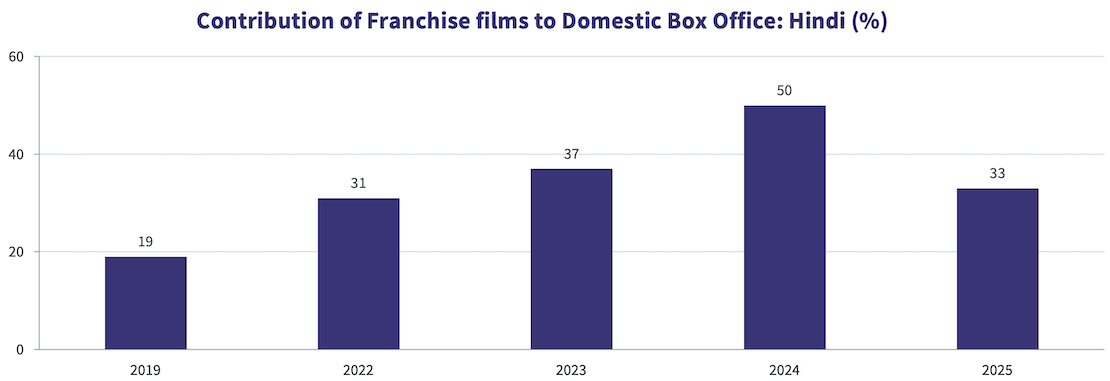
The trend leading up to this point was equally telling. Franchise contribution had steadily increased from 19% in 2019 to 31% in 2022, and further to 37% in 2023, before peaking in 2024 At that moment, it seemed like the industry had found a clear playbook for theatrical success.
But 2025 tells a very different story!
2025: A demand-side correction
2025 disrupts this narrative in a meaningful way. The share of franchise films dropped sharply from 50% to 33%, despite the supply side remaining strong, with over 20 franchise films releasing during the year. This is a critical shift. The decline is not due to fewer franchise films being made, but because audiences did not respond to them in the same way as before.
In many ways, this indicates that a degree of normalcy has returned to the theatrical market. Audiences are no longer defaulting to familiarity alone. Instead, their choices are becoming more selective, and driven by the inherent appeal of the film rather than just its IP.
This correction also exposes a key flaw in the industry’s recent thinking. The success of franchises in previous years was interpreted as a structural truth, rather than as an outcome of specific films working. 2025 makes it clear that scaling the volume of franchise films does not guarantee automatic success.
Content over formula
The most important learning from this shift is that franchise-building cannot be formulaic. The assumption that extending a known IP automatically improves the chances of success is being challenged. Films like Thamma may benefit from being part of a franchise, but that alone is not enough. What worked for films like Munjya or Stree was not just familiarity, but imagination, novelty, and a strong creative voice. Without that, the franchise tag becomes superficial and insignificant. The underwhelming performance of War 2 is another example.
This brings the focus back to content quality as the central driver of theatrical success. A known IP can help drive awareness and opening, but sustained performance depends on how engaging and differentiated the film is. Audiences are clearly evaluating films on merit, even within established worlds.
At the same time, this does not reduce the importance of franchises. Their role at the top end of the box office remains strong, with 6 of the top 10 Hindi films in 2025 being franchise films. First-day collections also tend to be more stable for franchise films, indicating that familiarity continues to play a role in driving initial traction. The shift, therefore, is not about relevance, but about how franchises are being approached.
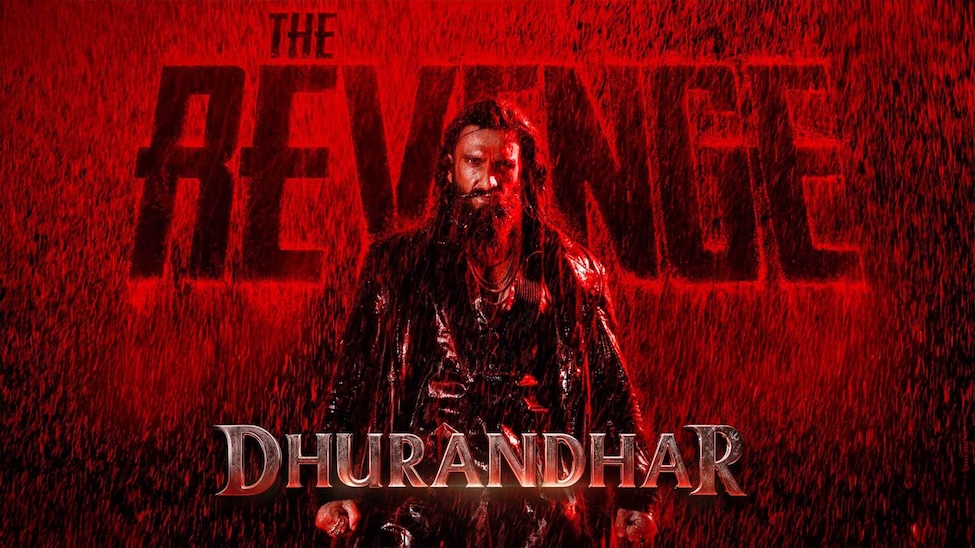
Ironically, the film that's a chief contributor to this trend reversal may also be reason why 2026 looks more franchise-skewed: The success of Dhurandhar, a non-franchise film in 2025, paved way for the record-breaking success of Dhurandhar: The Revenge, a franchise film, in 2026. This irony reinforces the 'content over formula' argument made above.
Balance and long-term thinking
The key implication for the industry is the need to rebalance the content slate. An over-reliance on franchises can limit the emergence of new ideas and lead to creative fatigue. Original films are not just complementary, but essential. They are the source of future franchises, and without them, the ecosystem weakens over time.
There is also a need to recognise that franchise-building is a long-term exercise. Global examples like the Marvel Cinematic Universe were built over time, with a clear vision and sustained investment, and not without setbacks along the way. In contrast, Bollywood has often shown a tendency to react quickly to perceived trends. The rapid scale-up of franchises post-pandemic is a reflection of that behaviour.
For franchises to deliver long-term value, they need conviction, patience, and a strong creative foundation. Simply extending successful films into sequels is unlikely to work consistently. Finally, a more balanced slate also helps reduce volatility at the box office. A franchise-heavy strategy concentrates risk in a smaller set of films, whereas a mix of franchises and originals distributes that risk more effectively.
The 2025 trend does not signal the decline of franchises. It simply puts them in perspective. They are not a guarantee of success, but one part of a broader, quality-led theatrical ecosystem.

Ormax Cinematix's FBO: Accuracy update (September 2026)
This edition of our monthly blog summarises Ormax Cinematix's box office forecasts (FBO) for all major September 2026 releases vis-à-vis their actual box-office openings

The India Box Office Report: August 2026
Driven by Hanuman Ansh, Toxic & Irumudi, August 2026 emerged as the best month of the year so far at the India Box Office, grossing ₹1,768 Cr

Ormax Cinematix's FBO: Accuracy update (August 2026)
This edition of our monthly blog summarises Ormax Cinematix's box office forecasts (FBO) for all major August 2026 releases vis-à-vis their actual box-office openings
Subscribe to stay updated with our latest insights
© 2026 Ormax Media Pvt. Ltd. All Rights Reserved.
Ormax Media Pvt. Ltd.
402, Signature,
Captain Suresh Samant Marg,
Andheri West, Mumbai 400053
Phone: +91 9324939911
Get to know us


We use cookies to improve your experience on this site. To find out more, read our Privacy Policy