


We are eight months into 2026, and Pritam and Pedro, the Rajkumar Hirani-created web-series on JioHotstar, has emerged as the most-watched Hindi web-series of the year so far. As on date, the series has clocked 23 Million unique viewers in India, as estimated by Ormax StreamView, which defines viewership as having watched at least 30 minutes of a property. By the end of its run, Pritam and Pedro is likely to finish closer to 27 Million, if not higher. No other web-series has crossed even the 20 Million mark in India this year.
There is a lot to unpack in that success. For years, the upper end of the streaming-viewership charts has been dominated by big-budget action-crime thrillers: high stakes, sprawling geographies, layered socio-political narratives and, preferably, enough guns to keep the prop department gainfully employed. Mirzapur, The Family Man, Farzi, and Special Ops have all occupied this space.
Criminal Justice has been something of an exception: crime-led, but handled with enough lightness and emotional accessibility to make it more inclusive and wholesome than the conventional dark thriller, as elaborated in this 2025 franchise deep-dive. Pritam and Pedro takes that baton forward, and does so remarkably well. Its success is not merely about viewership. With an Ormax Power Rating (OPR) of 76, it is the most-liked non-franchise Hindi web-series since 2024.
OPR is Ormax Media’s proprietary metric for measuring audience likeability across content categories, including theatrical films, streaming originals and linear television shows. Reported on a 0-100 scale, it represents the inherent content strength of a property and also serves as a surrogate for advocacy: the likelihood that viewers will recommend it to friends or family. OPR is a critical parameter across our content-testing tools, including Ormax Stream Test for streaming originals.
The chart below lists the Top 10 most-liked non-franchise Hindi web-series launched between January 2024 and July 2026.
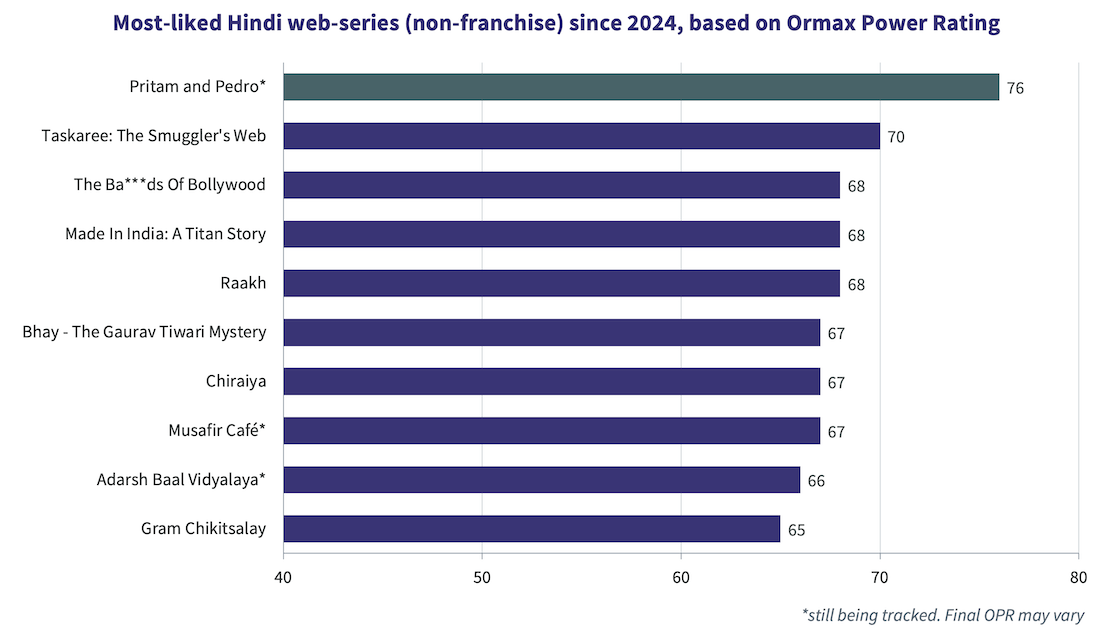
The combination of high viewership and exceptional likeability tells us something important about Pritam and Pedro: its success comes from being unusually inclusive.
That matters because streaming in India is now operating in a very different device environment. For much of its first decade, Indian streaming was essentially a single-device category, dominated by the smartphone. Quietly but rapidly, it has become a two-device category. Connected TV, or CTV, is that second device.
CTV does more than enlarge the screen. It changes who is sitting in front of it. Web-series, once designed largely for solo consumption, are increasingly being watched by couples and families in the living room. Even as I write this, Musafir Café, a series in the chronically under-exploited romance genre, is clocking strong numbers for Netflix in India.
The signs are increasingly difficult to ignore. We may finally be moving beyond an era in which “premium streaming” was almost automatically interpreted as dark, gritty, and gory. Established franchises created during the pre-CTV years will continue to perform. But new IPs that want to cross the 20 Million-viewer barrier will increasingly need to be demographically inclusive, appealing not just to young men but also to women and older audiences. It is streaming’s equivalent of the four-quadrant movie Hollywood studios have traditionally chased.
Pritam and Pedro achieves this inclusivity through a combination of choices. None of them individually offers a ready-made formula. But together, they point towards what Hindi streaming originals could look like in the CTV era.
Simple is not a dirty word
Pritam and Pedro is set up and narrated as a fairly simple story. For years, Indian streaming originals have taken pride in complexity: multiple narratives, non-linear timelines, grey characters, and storytelling that appears to wear “we don’t spoon-feed our audience” as a badge of honour.
Pritam and Pedro almost does spoon-feed its audience. But importantly, it does so by choice rather than limitation. Much of the first two episodes is devoted to establishing the titular protagonists, played by Vir Hirani and Arshad Warsi respectively. We understand who they are, how they think, and why their relationship could work, before the show asks us to engage with anything more complex. Only once that foundation is firmly in place does the narrative begin expanding into more layered territory, from Episode 3 onwards.
In an era of divided attention, clear and accessible storytelling may actually be a strength, not a compromise.
The charm of relatable humour
“Why are the keyboard keys not arranged in alphabetical order?” A tech-challenged Pedro, punishment-posted to the cybercell, asks the younger and considerably more digitally fluent Pritam this question in frustration. It lands instantly because most of us have probably wondered about it at some point. Better still, the scene goes on to offer a reasonably authentic explanation.
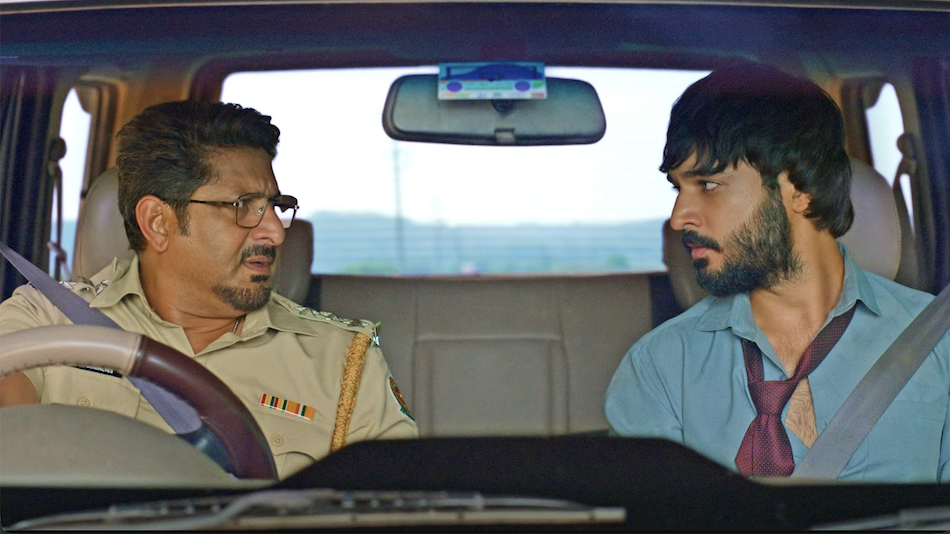
In another sequence, an influencer arrives at Pedro’s desk to complain about her missing “followers”. Pedro immediately looks over her shoulder to check whether anyone is actually following her. The digital era has reassigned meanings to a remarkable number of perfectly innocent English words, and “followers” is one of them. The joke is clearly written for viewers who are not digital natives. So is another moment involving files being stolen from the “cloud” during a server attack. Pedro’s immediate concern: hopefully, nobody was seriously injured.
The humour in Pritam and Pedro rarely comes from slapstick or elaborate comic situations. It comes from everyday observation: the tiny absurdities created when an analogue generation encounters a digital world. You may not laugh out loud every time. But the show earns your smile with impressive consistency.
From frivolous to purposeful
As the series progresses, there is an unmistakable Rajkumar Hirani touch to the way its tone evolves. The first two episodes suggest that we are watching a light, harmless buddy-cop show. But the arrival of Martin, played by Vikrant Massey, signals that the show has larger ambitions.
Episode 4, titled The Blue Whale, revives a not-so-distant cultural memory. In research among parents that we conducted about a decade ago, the Blue Whale menace would surface almost invariably. Yet, surprisingly little mainstream theatrical or streaming content has engaged meaningfully with that subject since.
Pritam and Pedro uses it as an entry point into the impact of technology on children and teenagers. That thread gradually becomes central to the series as we learn more about Pritam and Martin’s shared past, which involves Martin’s father, played by Boman Irani. What begins as a cheerful cybercrime escapade progressively acquires emotional and social weight.
And the final touch is unmistakably Hiraniesque. Forgiveness emerges as a larger theme, but it is never delivered as a sermon. Instead, it arrives through a delightful little song. A series that begins by making jokes about keyboards, followers and clouds, ends up saying something meaningful about technology, parenting, relationships, and human nature.
There’s a missing tape-recorder that strings through this narrative. It may or may not remind you of the one in PK, Hirani’s last film with genuine social commentary.
In conclusion
Pritam and Pedro arrives in a year that has also given us Chiraiya, Taskaree and Musafir Café. Together, these shows offer some clues about where Indian streaming originals may be headed next.
Critics who prefer streaming to remain the exclusive preserve of dark, violent and relentlessly edgy storytelling may not be entirely comfortable with this alternate future. Some of it may feel suspiciously like television. Some may dismiss it as pandering to the “masses”.
But perhaps “mass” is simply another word for more people, rather than the near-cussword Bollywood has managed to turn it into. For a category whose next phase of growth will increasingly depend on larger screens, shared viewing and broader demographic appeal, that may not be a bad audience to have.

K-Dramas in India: The growth story in numbers
Nine key data points from The Ormax OTT Audience Report: 2026 and Ormax StreamView, that showcase the growing consumption of K-Dramas in India

The Ormax OTT Audience Report: 2026
The latest edition of The Ormax OTT Audience Report sizes India’s digital video universe at 664.9 million users. The CTV universe has grown by a staggering 60% in a single year, to 206.9 million
The Connected TV Era: India's New Prime Time
A new report by WPP Media and The Trade Desk, in partnership with Ormax Media, explores India’s rapidly-evolving CTV landscape, and what that means for marketers today
Subscribe to stay updated with our latest insights
© 2026 Ormax Media Pvt. Ltd. All Rights Reserved.
Ormax Media Pvt. Ltd.
402, Signature,
Captain Suresh Samant Marg,
Andheri West, Mumbai 400053
Phone: +91 9324939911
Get to know us


We use cookies to improve your experience on this site. To find out more, read our Privacy Policy